
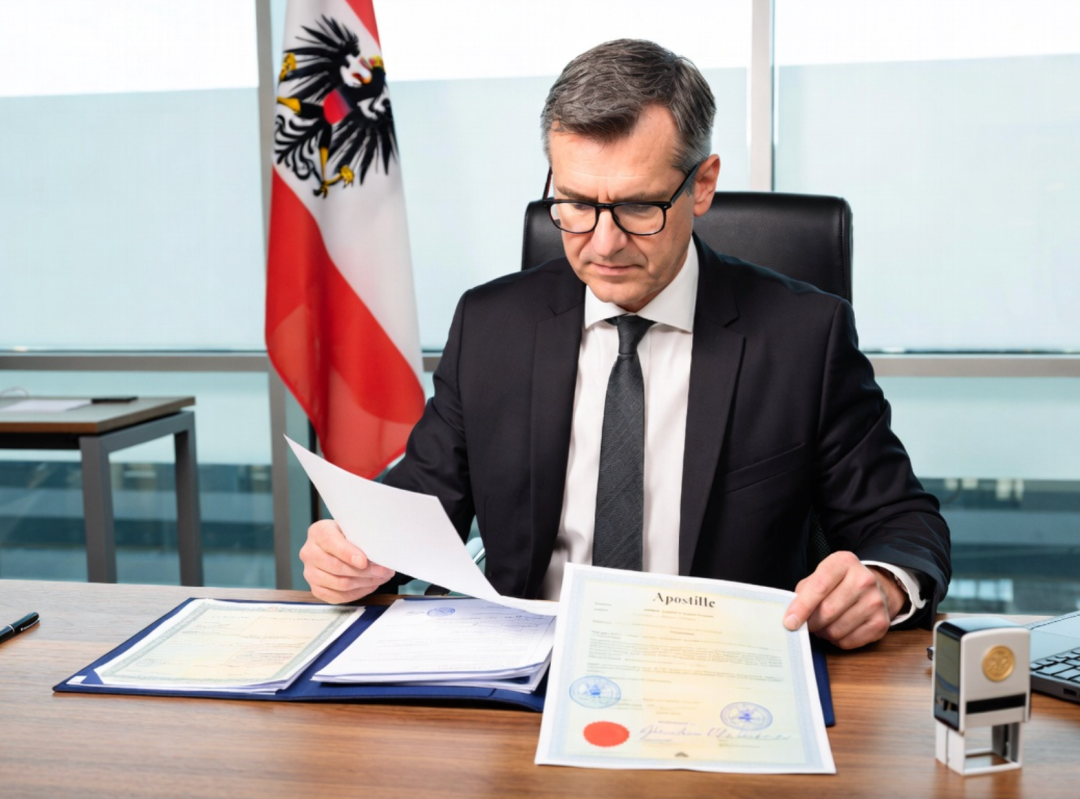
Austria Notarization and Apostille Guide: Everything You Need to Know About Processes, Common Documents, Timelines, and Costs
Complete Guide to Austrian Notarization and Apostille:
A Complete Guide to Procedures, Common Documents, Timelines, and Costs
Gongshitong | Global Notarization & Authentication
As economic and cultural exchanges between Austria and China grow increasingly frequent, many individuals need to use Austrian documents in China or other countries (e.g., for study abroad, immigration, employment, marriage, inheritance, or company registration), or to use Chinese documents in Austria. In such cases, notarization and the Apostille are essential steps. Austria is a member of the 1961 Hague Convention Abolishing the Requirement of Legalisation for Foreign Public Documents; the Apostille significantly streamlines international document processing by eliminating the need for cumbersome consular legalization.
1. What Are Notarization and Apostille Certification?
公证(Notarization):由奥地利公证员(Notar)对私人文件或签名进行认证,确认真实性和合法性。适用于私人文件如授权书、声明、合同等。
Apostille: A standardized international certification for public documents that verifies only the authenticity of the issuing authority, signature, and seal. Between Austria and other Hague Convention member states (including China, effective 2023 year 11 month), an Apostille is sufficient for mutual recognition; no further diplomatic legalization is required.
Note: An Apostille is not a translation and does not verify the authenticity of document content; it only certifies the form.2. Typical Process for Austrian Documents (For Use Abroad)
Obtain original documents: Collect birth certificates, marriage certificates, academic diplomas, police clearance records, court rulings, company documents, and other originals from relevant authorities.
Notarization may be required: Private documents or those needing signature verification typically require notarization by an Austrian notary public.
Apply for Apostille:
Federal Ministry for European and International Affairs (BMEIA) Legalization Office (Vienna): Handles federal-level documents.
President of the Regional Civil Court (Landesgericht): Handles court, notary, and prosecutor documents.
各州州长/州政府:处理地方行政文件。
Some overseas embassies and consulates may affix an Apostille to civil status documents they have issued.
Competent Authority (varies by document type):
In the target country (e.g., China), German documents typically require Chinese or English translations, and the accuracy of these translations may need further certification.
Submit: Apostilled documents are directly recognized in the destination country.
Submission methods: in person, by mail, or partially online. The Vienna Legalization Office accepts submissions without an appointment during business hours.
III. Common Documents Requiring Notarization or Apostille
Civil/Personal Documents: Birth, marriage, and death certificates; police clearance certificate; nationality or citizenship documents; divorce decrees; name change records; and more.
Educational Documents: Academic and Degree Certificates, Transcripts.
Commercial/Legal Documents: Business registration extracts, Powers of Attorney, notarized deeds, court documents, inheritance records, and more.
Other: Official documents such as administrative certificates, architect/engineer certifications, etc.
Private documents typically require notarization by a notary public before applying for an Apostille.
4. Time and Cost (Reference: 2026 Years)Time:
Apostille processing: typically a few days to 2 weeks, depending on agency workload. On-site submission in Vienna may be completed the same day or within a few days.
Full process (including notarization, potential document re-issuance, and translation): 1-4 weeks. Expedited service is available to reduce the timeline for an additional fee.
Round-trail mailing adds time. Plan ahead, especially for study abroad or immigration deadlines.
Cost (approximate; subject to official rates and potential administrative fee adjustments):
Official Apostille fee: approximately €14-25 per document. Consular Apostille: approximately €40.
Notary certification: €50–€300, depending on document complexity.
German-Chinese/German-English translation + certification: €30–€100+ per page.
其他:邮寄、快递、行政手续费。批量办理可能优惠。
Total Cost: Civil documents start at a few thousand RMB; more complex documents cost more. Agency services incur additional handling fees.
Note: For details, please contact Gongshi Tong customer service. Fees are calculated per document.
V. Process for Using Chinese Documents in Austria (Reverse Reference)Documents from China require notarization by a domestic notary public, followed by an Apostille certification from the Chinese Ministry of Foreign Affairs or provincial foreign affairs office. After China joined the Hague Convention, the process was simplified to 2 steps and typically takes 3-10 business days.
VI. Practical Tips and Important Notes
Confirm requirements in advance: Contact the relevant authority in the destination country or the Austrian consulate to verify if an Apostille is required, the accepted translation languages, and the number of copies needed.
Original Priority: An Apostille is typically affixed to or attached with the original document and must not be separated.
e-Apostille: Partially supported; verify acceptance in the target country.
Validity: Apostilles generally have no fixed expiration date, but the underlying document may be time-sensitive.
专业帮助:语言不通或时间紧迫者,可找公事通等其他正规渠道。
Official Reference: The website of the Federal Ministry for European and International Affairs (BMEIA) of Austria is the most authoritative source.
Notarization and apostille certification have certain requirements, but the process is highly standardized. With proper preparation and the right authority selection, you can save significant time and costs. We hope this article helps you with your cross-border matters!
This information is compiled from public sources and is subject to the latest official regulations. Fees and timelines are subject to change; please verify details through official channels.